Spatiotemporal DPP
IoT becomes the Internet of Tapped Digital Product Passports
The reader is already in your pocket
TapDPP — the QDat.io reader for NFC NDPP tags — is now a public release on the Google Play Store, with the Apple App Store release following shortly. Anyone with an NFC-equipped phone can install it in one tap and turn the device already in their pocket into a fully recognized QDat.io reader: it writes the canonical https://tapdpp.qdat.io/<UID> URL onto a tag, publishes every tap live to the QDat.io broker, and lets the spatiotemporal resolver route one tag to different views from the When, What, and Where of each read.

From the Internet of Things to the Internet of Tapped DPPs
The Internet of Things promised that every object would carry its own data. In practice that meant powered sensors, gateways, and always-on networks — expensive to deploy, and silent the moment connectivity drops. The NFC Digital Product Passport flips the model. The object carries a passive NFC NDPP tag with no battery and no network of its own, and the reader is the smartphone already in everyone's pocket. When the reader is universal, the network is optional, and the data lives on the chip, the Internet of Things quietly becomes the Internet of Tapped Digital Product Passports — billions of objects that say what they are the moment a phone touches them.
Every tap is a spatiotemporal event
This is the idea TapDPP makes tangible, and it is the core of the SDPP architecture:
A Spatiotemporal Digital Product Passport — SDPP — answers a different question than a URL. Instead of asking "who looked up this product on the public web?", it asks "which tag was tapped, when, and where?".
RFID — NFC at the centimetre scale, RAIN UHF at the multi-metre scale — is a physical-layer primitive. The reader sees the tag at a specific time and a specific position, so every read is a triple created at the moment of interaction:
The same NFC tag tapped at a repair shop, a recycling centre, or a consumer's kitchen has an identical UID — but a different spatiotemporal tuple. The QDat.io resolver routes each tap to the appropriate DPP view from that tuple, server-side, inside the operator's own perimeter — not from the requester's IP address.
No app to host, no webpage to keep alive
What makes this scale is that the passport does not depend on anyone keeping a website online. The NFC Forum's NDPP specification defines an NDEF message that carries both the resolver URL and an optional embedded CBOR-LD payload — a compact binary form of the ISO 59040 Product Circularity Data Sheet. Modern Android and iOS already ship the CBOR codecs that decode it, bundled into the same identity stack that reads mobile driving licences. The chip is the DPP, the operating system is the parser, and a network resolver like QDat.io layers spatiotemporal routing on top only when you want more than the chip alone carries.
Why the app stores matter
Until now, TapDPP shipped as a sideloaded build. A public store release removes the last friction: one-tap install, signed distribution, and automatic updates — and, with the App Store release imminent, both major mobile platforms covered by the same wire format and the same resolver. The reader stops being something you provision and becomes something every visitor, technician, recycler, and regulator already has.
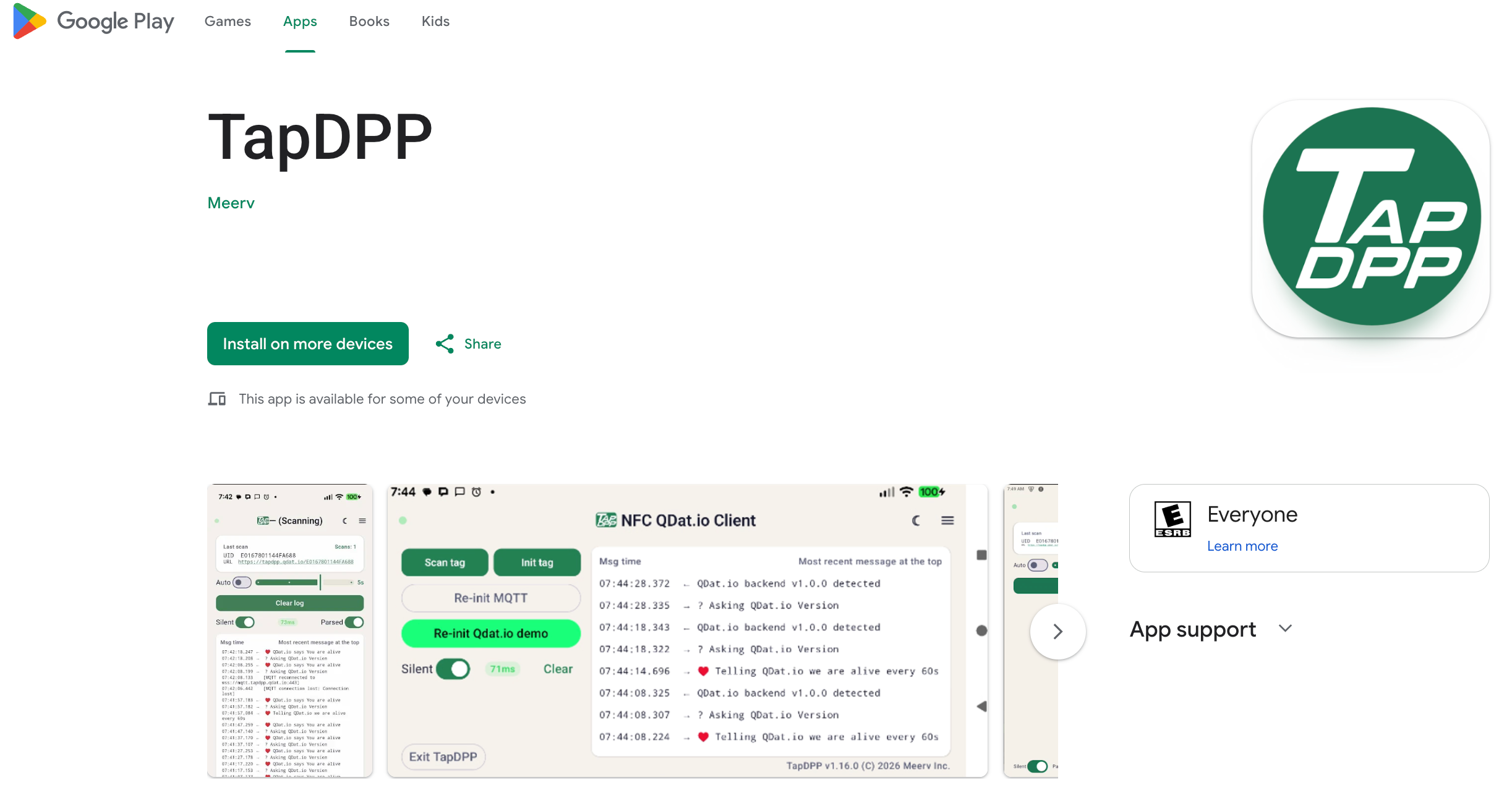
That is what turns the SDPP from an architecture into an everyday gesture: tap, and the object answers — here, now, to you.
Try it
Install TapDPP, tap a tag, and watch the same URL resolve to a live Digital Product Passport keyed to the When and Where of your read.
To run the resolver on-premise, inside your own perimeter, book a demo.
Ready to see QDat.io in action?
Book a live demo to see RFID spatiotemporal tracking and Cooldat® cold-chain workflows applied to your operations.
Book a Demo